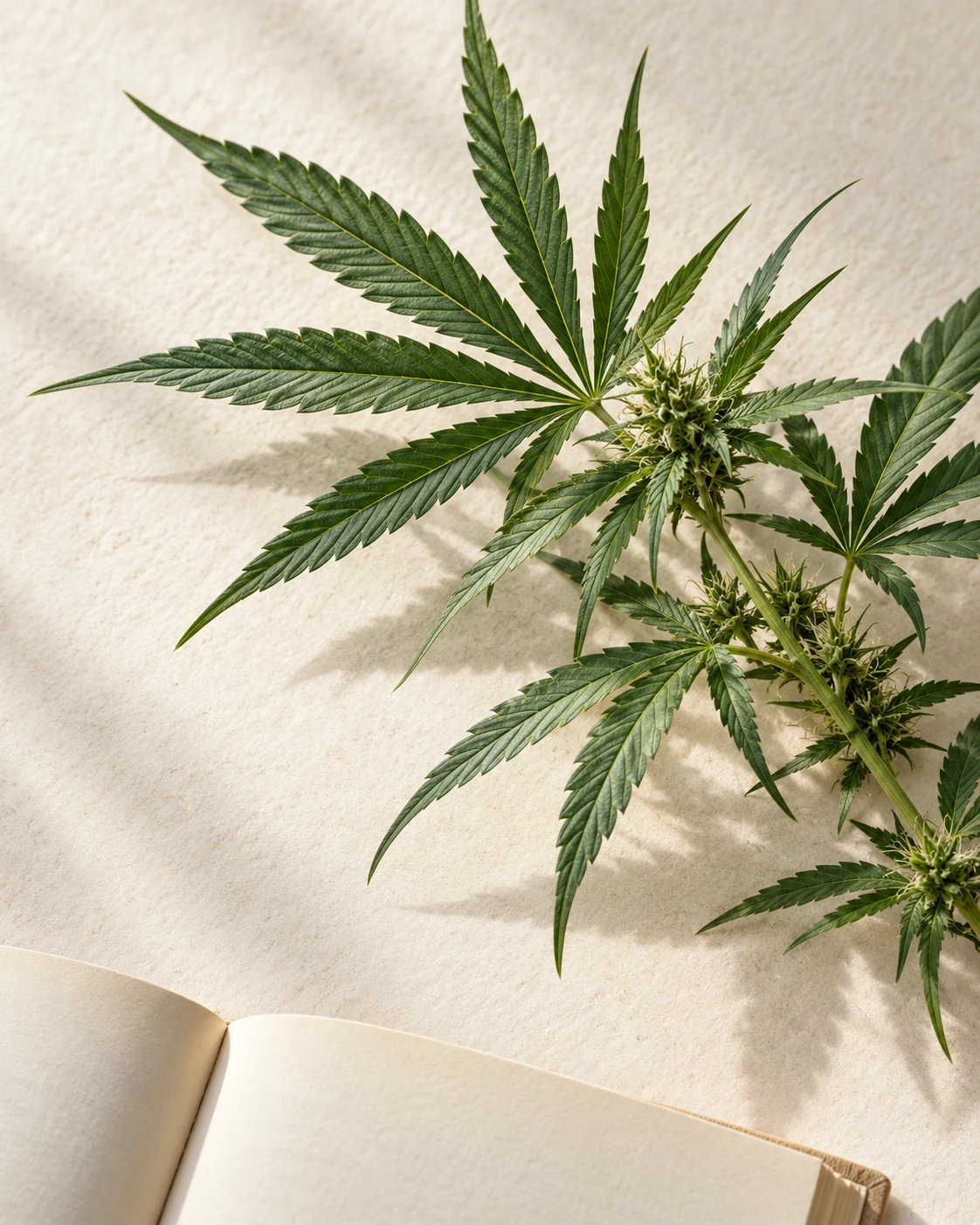
Full-spectrum usually describes an extract with several plant compounds, potentially including THC.
What Does Full-Spectrum CBD Usually Mean?
In common marketplace usage, “full-spectrum” describes CBD together with other compounds from cannabis. THC may be part of that mixture. The term helps introduce a composition question, but it does not provide a standardized list, a standard ratio, or a demonstrated health outcome for every item carrying the name.
The word “full” can sound like a promise that nothing useful was removed or that the product must be more effective. Those are additional interpretations. An ingredient description cannot establish either one without defining the compounds, the processing claim, and the evidence. Start with what the formula actually contains.
Ask whether the phrase describes a raw extract or the finished item. A manufacturer might use a full-spectrum ingredient and then dilute it into an oil, mix it into a gummy, or combine it with separately added ingredients. The final composition is the relevant question when discussing the package.
You do not need to decide whether the category is good or bad to understand it. Learn the common vocabulary, then move from the word to the ingredient list and batch measurements. Those details let you evaluate a particular description without treating a broad category as a personal recommendation.
Which Compounds Are We Talking About?
CBD and THC are cannabinoids, which gives them a family name without making their effects identical. Other cannabinoid names may appear on a label or report. Write them down separately and keep their listed amounts beside them. A combined “total cannabinoids” number may not tell you each ingredient's contribution.
Terpenes are another group of plant compounds, familiar in discussions of aroma. A cannabinoid panel and a terpene panel are different tests. A report listing several cannabinoids does not automatically quantify the aromatic compounds, and a noticeable smell cannot tell you their precise amounts or clinical importance.
NIST's measurement work addresses cannabinoid results and the challenge of reliable testing across cannabis materials and products.[1] This is useful context for why an attractive botanical description needs specific measurements. A plant origin and an analytical result provide different kinds of information.
Also distinguish compounds intentionally added from compounds measured in an extract. A formula can contain added flavors, carrier oils, or cannabinoids beyond the original ingredient. If a claim celebrates an unchanged plant profile, ask what the manufacturer means and which records support it. “From the plant” is not a complete formula.
How Does It Compare With Broad-Spectrum and Isolate?
Broad-spectrum usually describes an extract containing several plant compounds with THC intended to be removed. Isolate usually describes CBD separated from other cannabinoids. These are commonly used terms, not interchangeable certificates. Each finished item still needs its own ingredient information and appropriately matched test report.
The categories answer a composition question at a broad level. They do not tell you which preparation has evidence for a particular health outcome. A formula with more named compounds is more complex; whether it produces greater benefit is a separate comparison that needs meaningful clinical evidence.
Avoid comparing the names while ignoring the amounts. An item described as full-spectrum and another described as isolate could differ in CBD concentration, other ingredients, route, and package size. If several variables change together, any experience comparison cannot isolate the spectrum description as the cause.
Keep a simple written comparison: the claimed type, listed CBD, other listed cannabinoids, full formula, and test scope. If one entry is unknown, mark it unknown. A missing measurement should not be filled in using an assumption about the category. This approach makes uncertainty visible without inventing a product ranking.
What Changes Between an Extract and a Bottle?
An extract is an ingredient at a stage of production. A bottle, capsule, gummy, or cream is a finished formula. Moving from one to the other can involve dilution and added ingredients. A report about the ingredient may accurately describe that ingredient while leaving the final package's amounts unverified.
Consider a purely illustrative calculation. If one gram of an ingredient contains a stated amount of CBD and is mixed with additional carrier, the concentration of the mixture depends on the final quantity. A percentage describing the starting material cannot simply be copied to the entire finished mixture without considering that change.
This is why a supplier document and a batch document have different roles. The supplier document helps describe what arrived for manufacturing. A finished-batch report is more directly relevant to what was measured after formulation. Ask which material was sampled, not merely whether a laboratory logo appears on the page.
The same distinction applies to terpene or cannabinoid descriptions. A discussion of the plant's original profile does not show what remained after extraction, purification, storage, and formulation. The relevant evidence is a specific result or clearly described process claim, with its limits, rather than an assumption from a plant photograph.
How Do You Read the Cannabinoid Panel?
Begin with identity. Check the finished-product name, lot or batch, and sample description. Confirm that the report actually relates to the item being discussed. A familiar brand name alone is insufficient when several formulas or production batches exist. Read the dates as part of the record rather than overlooking them.
Next, read each analyte, meaning each substance measured. CBD, CBDA, delta-9 THC, and THCA are separate entries when included. If a report uses a “total” calculation, read its definition. Do not assume that a single THC number captures every related compound or every policy-relevant question.
Units matter. Milligrams per gram describe concentration by mass. Milligrams per milliliter describe concentration by volume. Milligrams per container describe a total. A percentage is another form of concentration. Numbers can only be compared directly when they refer to compatible units and the same material.
Finally, check what the panel does not cover. A narrow cannabinoid panel cannot prove that every possible compound is absent. If a seller lists an additional cannabinoid that the laboratory did not measure, its status remains a separate question. Ask for the scope and an explanation of discrepancies before treating the report as complete.
What Does Not Detected Mean for THC?
“Not detected,” often abbreviated ND, is a statement within a measurement method. It means the result did not reach the laboratory's stated detection or reporting threshold, according to its definitions. It does not prove absolute zero. Find the threshold and units rather than allowing two letters to carry a larger promise.
A detection limit concerns reliably distinguishing a substance from background. A quantification limit concerns reliably reporting its amount. Reports may use these terms differently in their presentation, so read the laboratory's notes. A low-level finding may need explanation if the report distinguishes detecting a compound from quantifying it confidently.
Here is an illustrative comparison. One report uses a lower threshold than another. Both might say ND while setting different limits on what could remain unmeasured. That does not make either result dishonest; it means the methods provide different information. The thresholds belong beside the result in any comparison.
Also distinguish ND from “not tested.” The second phrase leaves a much broader question open. Neither phrase guarantees how another sample, future batch, or workplace test will behave. If avoiding THC is important to your situation, a composition description and a sample result are useful details, but they cannot become an absolute promise.
Does a Spectrum Name Reliably Match Composition?
This question can be studied by testing products rather than surveying how people feel. A 2024 analysis examined 202 commercially available CBD items across tinctures, gummies, vape products, and topicals. It assessed labeled amounts and composition claims. Among products with full-spectrum, broad-spectrum, or isolate claims, 26% did not meet the investigators' definition for the claimed type.[3]
The result belongs to that sample and those definitions. It is not a current failure rate for every market or a finding that every product in one category is inaccurate. It is a concrete example of why investigators compare a claimed spectrum description with actual analytical measurements.
Read the authors' methods when interpreting such a study. How did they choose products? What did they count as matching a category? Which substances were measured? A category result depends on those choices. A strong reading keeps the study's operational definition visible rather than assuming an unstated universal standard.
For a particular package, the practical question remains specific: do its label, ingredients, and matching batch report agree? A market study raises useful concerns but cannot assay your item. Likewise, a reassuring report for one sample cannot erase broader uncertainties about another formula or manufacturing run.
What Is the Entourage Effect Claim?
“Entourage effect” is often used for the idea that several plant compounds may interact in ways that alter their effects. An interaction is a scientific possibility that can be tested. A claim that a particular retail mixture works better for a particular concern needs more than an appealing name for that possibility.
Ask what kind of interaction is proposed. Is one ingredient changing another's exposure? Is a cell pathway changing? Is a symptom outcome improving? These are different hypotheses. A measurement supporting one does not automatically support the others. The term should help define the experiment rather than replace it.
A fair clinical comparison needs adequately described formulations and an appropriate outcome. If the mixtures differ in several ingredients and CBD amounts, interpreting the reason for a difference becomes harder. A study may establish an effect of the whole tested preparation without establishing which component or combination caused it.
Keep botanical complexity separate from demonstrated benefit. A broad extract can be interesting to research while an individual product claim remains unanswered. Look for the actual human comparison and whether the reported difference matters to patients. Neither a mechanism diagram nor a long cannabinoid list supplies that comparison by itself.
Can CBD Be Assumed to Neutralize THC in a Mixture?
No mixture should be treated as self-canceling because CBD appears beside THC. A randomized crossover experiment in 46 healthy, infrequent cannabis users compared vaporized preparations containing 10 milligrams of THC with several CBD amounts. In those tested conditions, CBD did not protect against the measured THC effects.[4]
This experiment concerned specified inhaled preparations and acute outcomes. It did not test every full-spectrum retail formula, establish a health benefit for a broad category, or provide a recipe. Its useful contribution is narrower: the presence of CBD did not justify an automatic protective assumption in that comparison.
A ratio on a package should therefore be read as a composition description. It is not a direct measure of impairment, effectiveness, or suitability. Two formulas can share a ratio while differing in absolute amounts, route, and other ingredients. Relative numbers cannot replace the full intervention description.
When reading a study of THC plus CBD, retain both names in your notes. The mixture answers a different question from purified CBD alone. If a seller uses a combination trial to support a CBD-only item, ask what evidence connects them. The contribution of CBD cannot be isolated by simply highlighting it in a headline.
What Should You Ask About Safety and Testing?
Full-spectrum is not a safety assessment. A clinician or pharmacist needs the exact formula, relevant health history, and medicines to discuss a personal concern. More plant compounds can mean more ingredients to review; the spectrum term itself does not decide whether the product is appropriate for someone.
For testing policies, the potential presence of THC deserves particular attention. The U.S. Department of Transportation warns that CBD use can produce a positive marijuana result and is not a valid explanation for a confirmed positive result under its rules.[2] Other programs need their own written-policy review.
Do not infer a policy answer from feeling sober, a hemp-origin statement, or a low percentage on a label. These statements address different questions. A laboratory panel also cannot guarantee a future workplace result. If the consequence matters, consult the responsible testing authority and preserve the applicable requirements in your notes.
Questions about legal status likewise depend on the product and activity, with current official requirements. A composition term cannot settle them alone. Keep medicine suitability, test policy, and legal rules separate when discussing a package. This makes it easier to identify the right professional or official source for each uncertainty.
What Would a Careful Comparison Look Like?
Imagine two oils with the same full-spectrum name. One report lists many cannabinoid results; the other lists only CBD and THC. You cannot immediately conclude that the first formula contains a richer mixture. The laboratories may have tested different panels. First compare the analytes included in each test.
Now imagine one report concerns a supplier's extract and the other concerns a finished oil. The sample identity changes what the documents can answer. Matching units and methods still would not make them equivalent finished-product records. Ask for the relevant batch information before interpreting the composition difference.
This example is intentionally about records, not a verdict on either imaginary product. A reader can discover that a comparison is incomplete without deciding that one item is better, worse, or false. Missing information is a legitimate result. It points to the next useful question.
For a healthcare conversation, add the proposed outcome and the actual research. Ask whether the cited preparation matches the formula, whether its human comparison supports the claim, and what safety issues matter personally. A composition comparison and a clinical comparison can inform each other while remaining distinct tasks.
What Are the Answers to Common Full-Spectrum Questions?
“Does full-spectrum mean exactly the same ingredients everywhere?” No. Read the actual formula and measurements. “Does it always mean THC is present at a known amount?” The usual description allows THC, but a particular amount needs the label and appropriate assay. The word alone is not a number.
“Is full-spectrum automatically more effective?” A category cannot establish superiority for every outcome. Find the relevant comparison. “Does ND mean absolutely no THC?” It is a method-limited result with a threshold. “Does a report prove benefit?” Composition testing and clinical effectiveness require different evidence.
“Is a purified-CBD trial a full-spectrum trial?” No. Keep the tested ingredients attached to the findings. “Can a long ingredient list explain why I felt different?” It may suggest questions, but it does not isolate cause. The whole formula, context, and an appropriate comparison matter.
“What should I request if the label is confusing?” Ask for the full ingredient description, explicit cannabinoid amounts, a matching finished-batch report, test definitions, and clarification of the specific discrepancy. The aim is understandable information about the actual item. Once that is clear, the health, safety, and policy questions can be evaluated with the evidence they need.
Sources & Further Reading
- NIST: Helping Labs Achieve Accurate THC and CBD Measurements ↗
- U.S. Department of Transportation: CBD Notice ↗
- Gidal et al.: Commercial CBD product labeling accuracy and composition analysis (2024) ↗
- Englund et al.: Cannabis with four CBD:THC ratios, randomized crossover experiment (2023) ↗
Sources checked October 5–6, 2026. This page is for general education. No medical review or endorsement is implied. Read the editorial policy.