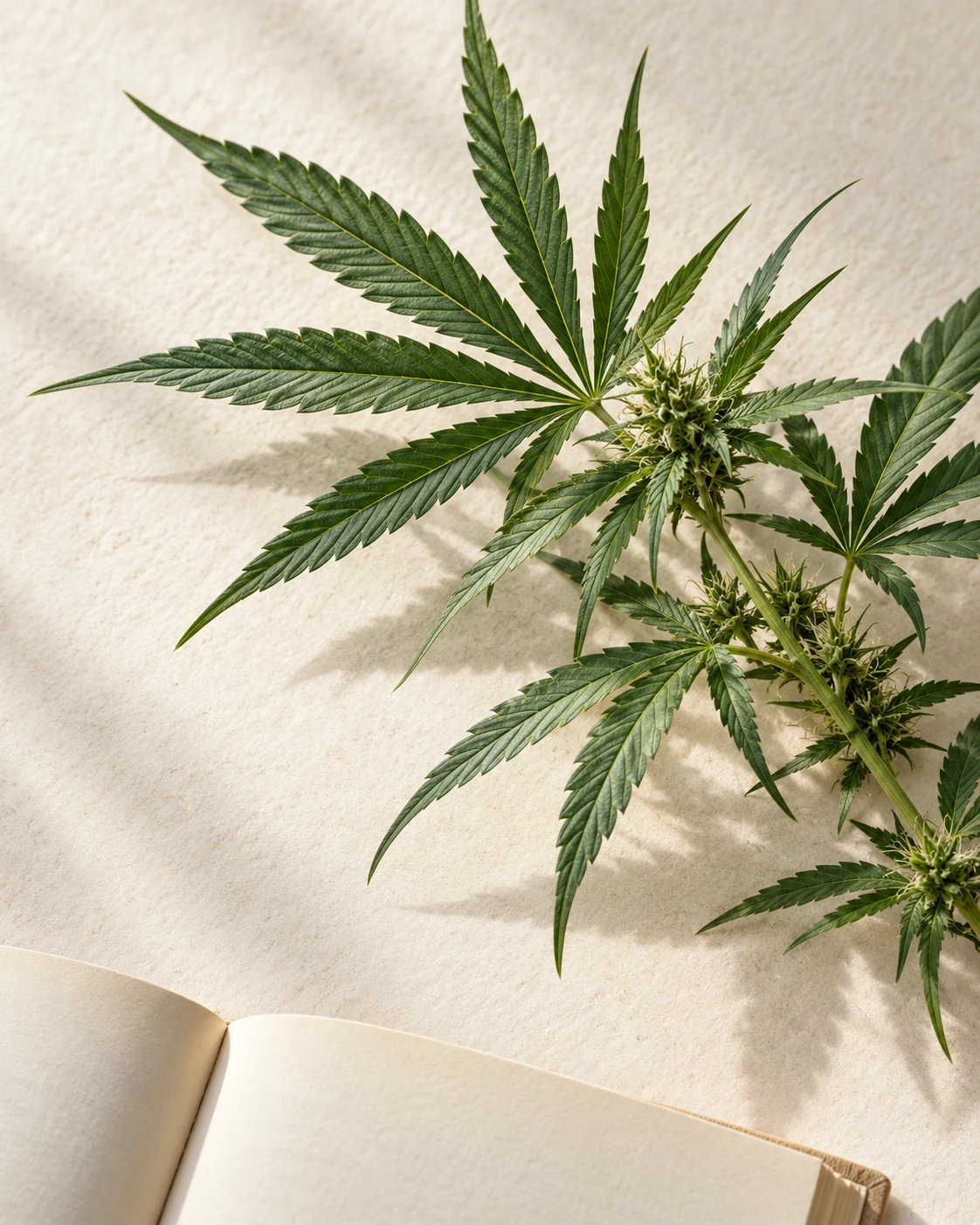
A body signaling system is a research subject, not proof that a CBD product corrects a deficiency.
What Is the Endocannabinoid System?
The endocannabinoid system is a collection of signaling molecules, receptors, and processes involved in making and breaking down those molecules. Endo means within: endocannabinoids are produced in the body. Two familiar examples are anandamide and 2-arachidonoylglycerol, usually shortened to 2-AG. CB1 and CB2 are two cannabinoid receptors central to this field.[1]
The name can make the subject sound as though it exists to receive cannabis. That reverses the useful biological picture. Researchers studying cannabis helped uncover signaling machinery already operating in animals and people. A plant compound can interact with a biological target without being the reason that target exists.
Think of the system as communication with several components. A signal must be produced, encounter an appropriate target, and change over time. The receiving cell's circumstances matter too. Listing a molecule and receptor is a start, yet it is not the whole explanation of what happens in a tissue.
This background helps you understand cannabis research and evaluate scientific-sounding claims. It does not establish a need for CBD, diagnose a deficiency, or identify a personal treatment. We will follow the vocabulary far enough to make it useful without turning a complex signaling network into a wellness promise.
How Did Scientists Find It?
The discoveries came in stages. A 1990 paper described the structure and functional expression of a cloned cannabinoid receptor associated with the central nervous system, now known as CB1. A 1993 paper characterized another cannabinoid receptor, now called CB2, in a peripheral immune context.[4][5] These were investigations of biological targets, not evidence that a retail product should be used.
Once researchers had a receptor, an important question followed: what substances made within the body interact with it? In 1992, scientists reported isolating a brain constituent that bound to the cannabinoid receptor. That molecule became known as anandamide. In 1995, another study identified 2-AG from canine intestinal material and investigated its cannabinoid-receptor activity.[2][3]
There is an instructive difference between identifying a signaling component and proving a clinical benefit. The early experiments helped establish what molecules and targets existed. They did not test whether an oil on a shop shelf improved a condition in people.
You do not need to memorize the dates. Their purpose is to show how a scientific picture develops: one result leads to a new question, then another experiment adds detail. Modern claims should preserve that chain of evidence instead of making a discovery sound like a universal treatment recommendation.
What Are Anandamide and 2-AG?
Anandamide and 2-AG are lipid-derived signaling molecules. Lipid here refers to their chemical context, not to a recommendation to eat a particular oil. They are distinct molecules with distinct production and breakdown pathways. Their shared role in cannabinoid signaling does not make them identical or interchangeable.
The discovery studies examined specific material and laboratory measurements. The anandamide work identified a compound from brain material that bound a cannabinoid receptor. The 2-AG study identified a molecule from intestinal material and investigated its activity.[2][3] That illustrates how scientific names can grow out of carefully bounded observations rather than a general claim about happiness or balance.
A helpful reading habit is to write the molecule beside the result. Did the investigators measure anandamide, 2-AG, another related lipid, or an administered plant cannabinoid? An article that replaces all those names with cannabinoids can lose the distinction needed to interpret its findings.
These body-made molecules are also different from cannabidiol. They do not become CBD because they share a research field. Nor does evidence that a signaling molecule participates in a process establish that taking CBD reproduces the same process. The mechanism, tissue, timing, and experiment all need to be identified before making that connection.
What Does a Cannabinoid Receptor Do?
A receptor is a biological target that helps a cell respond to a signal. CB1 and CB2 are members of the G protein-coupled receptor family. That term describes receptors whose activation connects to signaling machinery inside a cell. You do not need to know every intermediate step to understand why the target matters.
The receptor-discovery papers established important parts of this picture through cloning and functional experiments.[4][5] A simplified diagram might show one signal touching one receptor, but an actual response depends on more than that encounter. The receptor's location, the receiving cell, and downstream processes all influence what happens next.
CB1 is strongly associated with nervous-system research, while CB2 has an important immune-system context. Treat brain receptor and immune receptor as introductory shorthand rather than rigid boundaries. A scientific claim should name the actual tissue and experimental setting instead of assuming a receptor exists in only one place.[1]
The familiar lock-and-key analogy can help with recognition, but it has limits. A compound may activate a target, block another signal, or alter a response through a different interaction. Simply saying binds does not explain whether signaling increases, decreases, or changes in a clinically meaningful way. Read the measured effect as well as the receptor name.
Why Do Enzymes Belong in the Story?
A signal's lifetime matters. Enzymes participate in the formation and breakdown of endocannabinoids, helping determine when and where signaling occurs. If you learn only the molecule and receptor, you miss an important part of the timing. A message that persists indefinitely is different from one that is generated and removed locally.
Two useful enzyme names are FAAH, fatty acid amide hydrolase, and MAGL, monoacylglycerol lipase, also called MGL. Research characterized FAAH as an enzyme capable of breaking down anandamide, and investigated MGL's participation in 2-AG inactivation.[6][7] Those named pathways help researchers ask more precise questions than simply whether the system is active.
Imagine an entirely hypothetical experiment in which a molecule's measured level rises. That could reflect increased production, slower breakdown, movement between compartments, or a combination. The level alone does not tell you which explanation is correct. Investigators need measurements or manipulations designed to separate the possibilities.
This is also why boosting a signal is not a complete health claim. A change in quantity may have different implications in different tissues and circumstances. Finding an enzyme target can guide drug research while questions about benefit, harms, and appropriate clinical use remain open. It does not establish a consumer supplement requirement.
What Is Retrograde Signaling?
Retrograde signaling is communication that travels back toward the sending side of a connection. In a common simplified picture of a synapse, one neuron sends a chemical message and another receives it. Endocannabinoid signaling can help the receiving side influence subsequent release from the sending side.
A 2001 study investigated this process at hippocampal synapses and showed endogenous cannabinoid involvement in a particular form of transient suppression of GABA-mediated transmission.[8] This is a specific finding in neural signaling, not a description of every endocannabinoid event or an explanation for every feeling associated with cannabis.
As an analogy, imagine a person receiving a stream of messages and sending back a request that changes the incoming flow. The return message helps adjust communication. In the biological case, the transmitter, receptor location, and circuit matter. Reducing release of an inhibitory transmitter can have a different overall effect from reducing release of an excitatory one.
That last distinction is easy to miss in a headline saying cannabinoids turn down brain activity. A local change in transmitter release does not establish one uniform effect across the entire brain. The details make the finding more interesting and more accurate. They also show why a neat mechanism illustration cannot predict whether a retail CBD formula will make someone calm, sleepy, or symptom free.
What Does the System Have to Do With Everyday Biology?
Endocannabinoid research touches nervous-system activity and processes outside the brain, including immune and metabolic questions. The field's breadth reflects the number of tissues and interactions being investigated.[1] It should not be read as a list of conditions that CBD has been proven to treat.
A useful distinction is between participation and control. If a signaling component participates in a process, it may be one contributor among many. Describing it as the master regulator of sleep, appetite, stress, or pain can make a multifactorial process sound simpler than the evidence supports. An explanation needs the specific pathway and the level at which it was tested.
Consider a hypothetical animal experiment recording a change in feeding behavior after a receptor manipulation. It can reveal something about that model. It does not demonstrate that a CBD oil causes weight loss in people. The intervention, species, circumstances, and outcome differ before the consumer product even enters the discussion.
You can appreciate why researchers investigate the system without adopting every proposed use. The right next question is which human outcome has been tested with which intervention. This preserves the value of basic biology while leaving clinical conclusions attached to clinical evidence. Our research guide helps readers make that transition.
Where Do THC and CBD Fit?
Plant cannabinoids are external compounds rather than body-made endocannabinoids. THC can interact with cannabinoid receptors and has an intoxicating profile different from CBD's. Cannabidiol is also a plant cannabinoid, but it should not be explained as a simple replacement for anandamide or 2-AG. The names describe different substances.
Researchers investigate several possible CBD mechanisms. One original study examined fatty acid-binding proteins as intracellular carriers for THC and CBD and considered their relationship to anandamide handling.[9] This laboratory work helps explore how compounds move and interact. It does not prescribe a retail product or establish its clinical usefulness.
When a claim says CBD works on the endocannabinoid system, ask what works on means. Does the source describe receptor binding, an enzyme-related process, a change in a measured molecule, or a hypothesis? Then ask whether that event has been demonstrated under the conditions relevant to the claim.
A cell experiment's concentration may not be comparable to the exposure achieved by a particular human formulation. A clinical result also cannot be explained solely by pointing to a familiar pathway. Keep the experimental mechanism, measured patient outcome, and product composition in view together. The CBD mechanism guide examines that distinction in more detail.
Is Homeostasis the Same as Perfect Balance?
Homeostasis describes physiological regulation around changing needs and conditions. It does not mean that every signaling molecule has one ideal level at every moment. Bodies respond to context, and local biological signals can change as part of ordinary regulation. The word balance is appealing, but it needs a definition before it becomes a scientific result.
For an illustrative example, imagine a company saying its oil restores endocannabinoid balance. A testable version would need to identify what measure was altered, how the alteration was established, and which meaningful outcome changed after the intervention. Without those details, the phrase describes an aspiration rather than a demonstrated finding.
Even a measured change would raise follow-up questions. Was it measured in blood, a specific tissue, or an experimental cell model? Does that measurement represent the process the company discusses? Was the change beneficial, neutral, or associated with an unwanted effect? More or less is not automatically better.
An analogy with room temperature can introduce regulation, but it cannot supply a universal biological thermostat setting. There are many interconnected processes, and they do not all respond identically to one substance. The safest intellectual habit is to replace a vague promise of balance with a named measure, a defined intervention, and a clear outcome.
Can an Endocannabinoid Deficiency Be Diagnosed From Symptoms?
A collection of everyday symptoms does not establish a diagnosed cannabinoid deficiency or show that someone needs CBD. Research hypotheses about endocannabinoid function should be distinguished from validated clinical diagnostic criteria and established treatments. A scientific-sounding name does not perform an examination or exclude other explanations for a symptom.
To evaluate a claimed diagnosis, ask how it is defined. Is there a validated test? What does the test measure, and how accurately does it distinguish the condition from alternatives? Has changing that measure improved patient outcomes in appropriate studies? A hypothesis needs those steps before it can support routine clinical decisions.
Imagine a hypothetical online quiz that links tiredness, stress, and discomfort to a deficient system and directs every result to a cannabinoid product. The quiz has not established the cause of those experiences. Its use of receptor terminology does not fill the diagnostic gap. Persistent or concerning symptoms deserve an appropriate healthcare assessment.
The system's existence also does not establish a dietary requirement for CBD. Medicines can affect biological pathways without replacing a missing nutrient. In the same way, studying endocannabinoid targets does not make a plant cannabinoid necessary for everyone. Keep discovery, mechanism, diagnosis, and treatment as separate stages of the evidence.
How Can You Read an ECS Study Without Getting Lost?
Start by finding the experiment's subject. A study might use a receptor engineered into cells, an animal model, tissue samples, healthy volunteers, or patients. Write that beside the claim. It immediately tells you whether the paper is examining molecular behavior or directly testing a clinical outcome.
Next identify the intervention and measurement. Was a signaling molecule administered? Was a receptor altered? Was an enzyme inhibited? Did researchers measure chemical binding, transmitter release, behavior, symptoms, or adverse effects? These choices define what the experiment can answer. A general endocannabinoid label can hide those differences.
Then examine the comparison. A useful comparison helps separate the proposed explanation from alternatives. In a hypothetical cell experiment, removing a receptor might help show whether it contributes to an observed effect. That is valuable mechanistic evidence, yet it still leaves questions about human exposure and patient benefit.
Finally, follow the result only as far as the design supports. A plausible pathway and a negative clinical trial can coexist; biology is complicated enough that a reasonable mechanism may not yield the hoped-for outcome. Do not discard one type of evidence to make the story tidier. Use it to refine the next question rather than to promise a product effect.
Questions Readers Often Ask
Was the system created by cannabis use? No. It is body signaling machinery studied through cannabinoid research. Its name reflects that scientific history. The discovery of targets for plant compounds did not mean that those targets require people to consume the plant.
Is there one blood number that shows the whole system's health? A measurement of a particular molecule in a particular sample is not automatically a complete account of signaling throughout the body. Ask what the test is validated to show and how the result changes clinical care before treating it as a diagnosis.
Does affecting the system mean an ingredient is safe? No. A mechanism describes an interaction, while safety requires its own evidence. FDA information identifies risks and unresolved questions about CBD.[10] An interesting biological explanation cannot replace an assessment of the exact formulation, medicines, and health situation.
What should I remember after the terminology? Body-made signals, receptors, and enzymes form the starting framework. The details of timing, tissue, and experimental conditions shape the interpretation. CBD is a separate compound, and a retail formula is another subject again. Follow those distinctions and the science becomes easier to read without turning uncertainty into a wellness guarantee.
Sources & Further Reading
- Zou and Kumar: Cannabinoid Receptors and the Endocannabinoid System ↗
- Devane et al.: Isolation of anandamide (1992) ↗
- Mechoulam et al.: Identification of 2-AG (1995) ↗
- Matsuda et al.: Cannabinoid receptor structure and expression (1990) ↗
- Munro et al.: Peripheral cannabinoid receptor characterization (1993) ↗
- Cravatt et al.: Fatty acid amide hydrolase characterization (1996) ↗
- Dinh et al.: MGL and 2-AG inactivation (2002) ↗
- Wilson and Nicoll: Retrograde endocannabinoid signaling (2001) ↗
- Elmes et al.: Intracellular carriers for THC and CBD (2015) ↗
- FDA: What to Know About Cannabis-Derived Products, Including CBD ↗
Sources checked October 5–6, 2026. This page is for general education. No medical review or endorsement is implied. Read the editorial policy.